

The Incompleteness Theorem
Reflections on Strategy from the Cold War

On May 19th, Elbridge Colby, the Undersecretary of War for Policy, gave an important speech at the National War College. Mr. Colby’s remarks were an eloquent and official elucidation of a line of strategic thinking he has developed over roughly two decades, perhaps most efficiently summed up in an article entitled “Against the Great Powers.” There is much to like in the speech (and article)- it is clear, cogent, and largely compelling. Yet as a theory of victory for the United States and its unique geostrategic position it is incomplete. In this essay I will comment first on what is in the speech- and laudable- before turning to what is elided.
The Central Strategic Problem: Asymmetric Stakes and War with Nuclear Armed Great Powers
As diagnosis of the problem facing the United States, the speech is precisely correct:
…the central strategic problem our military strategy must solve: How can the United States effectively defend critical interests against strong and resolute major power adversaries while maintaining the costs and risks for Americans at levels rationally proportionate to their interests at stake?
Mr. Colby also rightly observes that there may be real or perceived asymmetry of stakes between the United States and these adversaries, where the adversaries at least believe “the stakes as more immediate, more proximate, and more directly connected to prestige, legitimacy, security, and political survival than Americans do.” The adversary’s beliefs in this case may be wrong- but it may take a crisis or even failure of deterrence for this to be revealed.
This asymmetry of stakes is challenging because adversaries with large and diverse nuclear arsenals can choose to escalate. Mr. Colby notes nuclear escalation makes “unlimited war among major powers extraordinarily dangerous and almost inherently irrational.” Indeed, rationality is perhaps the leitmotif of strategy in the speech, appearing eight times in relation to strategy and stakes. If stakes are asymmetric, the adversary may believe the United States cannot rationally run existential nuclear risks to defend an interest that, however vital, is not existential. The shadow of nuclear escalation enabled by (perceived) asymmetric stakes will logically then enable adversaries to either deter U.S. involvement in conflict in the first place- or to coerce termination of a conflict on terms favorable to the adversary. This is, as they say, a bit of pickle.
What Is to Be Done? Denial, Escalation Management, and Binding
What then is to be done in terms of military strategy? Mr. Colby points to the 2026 National Defense Strategy, which he characterizes as providing:
…a military-strategic framework for addressing this difficult problem. This framework is composed of three core elements.
The first element is denial defense – specifically, denying an opponent the ability to seize and hold the key territory of a U.S. ally or partner, thereby preventing them from acquiring the leverage necessary to subordinate that state and overturn a favorable regional balance of power, in line with the National Security Strategy’s geopolitical guidance.
The second element is favorable escalation management – placing the burden of escalation, or the costs and risks of initiating escalation, on the opponent, keeping it there, and making it progressively heavier through sustained denial and selective, strategically rigorous cost imposition.
The third element is a binding strategy – structuring the conflict so that the opponent’s attempts to escalate out of frustration or failure strengthen coalition cohesion, deepen allied resolve, and reinforce the balancing coalition opposing aggression.
These three elements are eminently sensible, and were integral to U.S. strategy in the Cold War, particularly the late Cold War. Indeed, in a speech with multiple references to architects of the Cold War Kennan, Kennedy, and Kissinger, one would expect such historical anchoring. In terms of denial, the 1970s and 1980s saw investments in U.S. conventional military modernization, often termed “The Second Offset,” intended to enable a significant conventional defense of key territory in Europe. The same period saw refinements in U.S. nuclear strategy to produce limited nuclear options using strategic nuclear forces as well as enhancements in U.S. theater nuclear forces- all intended, at least in part, to support escalation management (sometimes called “escalation control”). Finally, the cohesion and resolve of U.S. alliances was a perpetual source of both strength and headaches for U.S. leaders from Eisenhower to Reagan.
If a similar framework succeeded in addressing the Cold War challenge of confronting a nuclear armed great power (a point some contest but I believe to be correct), then there is a strong prima facie case to be made that it will be successful in the 21st century. Yet Mr. Colby’s speech is incomplete in its modernized invocation of the Cold War military-strategic framework, leaving out a vital element from other architects, perhaps most notably James Schlesinger.
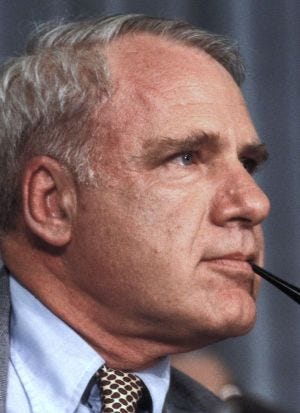
Secretary of Defense Schlesinger. Image courtesy of IMDB.
What We Talk About When We Talk About Escalation
As I have noted elsewhere (some would say ad nauseam- apologies to those readers), the central strategic problem Mr. Colby ably sketches led many U.S. nuclear strategists to conclude that escalation control and limited nuclear options were necessary but not sufficient. As James Schlesinger remarked just before the Cuban Missile Crisis:
Unless the Soviets are less shrewd or less technically competent than we think them to be, eventually they will provide themselves with a relatively invulnerable counter-deterrent, which, permitting a much higher percentage of Soviet military might to survive, will increase the risks to the United States of a large-scale counterforce strike. Will this be in 1965, 1968, or 1970? If massive nuclear exchanges are to be avoided—and both superpowers have a dramatic incentive to do so—the chief possibility for dissuading the Soviets from major provocations is to threaten carefully measured attacks against military targets or cities—deterrence on a tit-for tat basis.
Dr. Schlesinger thus agreed with Mr. Colby on the disincentive for large scale nuclear exchanges, and thus homed in on the same sort of solution: escalation management aka “carefully measured attacks.” Yet Schlesinger went a step further in his logic:
In a war of nerves, with limited encounters, which side will prove the stronger—especially when we have reached the city-swapping stage? How long will the American public accept a game played by these rules?
Mr. Colby acknowledges this dilemma in one part of the speech:
…strategies relying primarily on punishment or cost-imposition are also deeply problematic. Such approaches often appear attractive because they promise asymmetric leverage at relatively low cost. But this is usually an illusion. In the first place, an imposition of cost does not prevent a resolute opponent from seizing territory, nor plausibly reverse it. But it can anger him, and nuclear-armed major powers possess substantial capacity to inflict pain on us as well. Thus our imposition of cost on the adversary invites him to respond by applying pain to Americans – and the more painful our application is, the more painful it is likely to be for our citizens. Moreover, even leaving aside the grievous costs such strategies are likely to entail, they are not likely to work, as competitions in pain tolerance frequently advantage the side perceiving the conflict as more vital, which is likely to be our opponent in such a struggle.
Yet this logic does not appear in the section of the speech describing favorable escalation management:
…selective and strategically disciplined cost-imposition becomes increasingly salient. Here Schelling’s insight that “the power to hurt is bargaining power” is very relevant. Selective cost imposition, however, must reinforce, not undermine, denial of the original objective of the aggressor. It also must remain ever-conscious of the need to avoid catastrophic escalation, especially involving nuclear weapons at scale… Its purpose, rather, must be coercive diplomacy: persuading the opponent that continued escalation will progressively worsen his strategic position while improving neither his military prospects nor his political leverage… If we can do this, even a major power nuclear-armed opponent will face the strongest set of incentives not only to conclude the conflict, but also do so in ways that limit the costs to regular Americans.
If the adversary is likely to prevail in “competitions of pain tolerance” how will selective cost imposition (aka pain) persuade him that continued escalation will not favor him? Won’t the adversary “respond by applying pain to Americans – and the more painful our application is, the more painful it is likely to be for our citizens?” Dr. Schlesinger certainly was concerned that this would be the result.
Yet it is possible that the adversary may, when confronted with selective cost imposition, realize he has miscalculated. U.S. resolve is greater than he anticipated, U.S. capability more flexible and ingenious than he believed. The stakes were not, after all, quite so high as the adversary believed.
It is this possibility that led U.S. Cold War nuclear strategists to embrace limited nuclear options- to give the U.S. president the ability to engage in exactly the sort of coercive diplomacy Mr. Colby refers to. When he became Secretary of Defense, Dr. Schlesinger was intimately involved in reviews of U.S. nuclear strategy, ultimately producing guidance for the military that translated presidential objectives into concrete planning direction. This document, the Policy Guidance for the Employment of Nuclear Weapons (NUWEP), is now almost entirely declassified, and devotes significant attention to the strategic concept of escalation control. It also provides three principal objectives for developing limited nuclear options:
(1) To indicate to the Soviet Union or the People’s Republic of China that issues attendant to local conflicts are part of the vital interest of the United States
(2) To provide options for establishing or increasing the military superiority of U.S. and allied forces in a local conflict and to inhibit further enemy military operations.
(3) To provide responses to limited nuclear attacks by the Soviet Union or the People’s Republic of China on the United States, its allies, or its forces
These objectives seem entirely consonant with Mr. Colby’s element of favorable escalation management. Yet Dr. Schlesinger no doubt recalled his own words from the previous decade and thus that planning for limited options was necessary but not sufficient. The NUWEP plans for the possibility that limited options could still lead to a large-scale exchange or a contest of pain that favors the adversary. It therefore articulates planning guidance “to the extent escalation cannot be controlled.”
The guidance here is clear and stark. An option was to be developed intended to “neutralize the Soviet nuclear threat to the United States.” Another is intended to “neutralize the Soviet nuclear threat to major urban areas of the North Atlantic Treaty Organization (NATO) other than the United States and Canada.” These options were to plan to comprehensively attack the nuclear threat, including national leadership, command and control, and all manner of fielded nuclear forces. The guidance stipulated that
…in a U.S. attack planned with fully generated undamaged forces on the Soviet nuclear threat to the United States and its allies, not less than one warhead should be applied to each ICBM site, each IRBM and MRBM site, each base for heavy, medium, and light bombers, and each base for missile-launching submarines, even if a high damage expectancy cannot be achieved or only short-term damage can be realized.
The guidance also called for tailoring these damage limiting options with the potential to withhold execution against particular target sets. These included national leadership, to potentially permit negotiations even after a large-scale damage limiting strike. Urban targets were also prohibited in these options, to provide Soviet leaders an incentive to terminate conflict- they would still have much to lose if they chose to retaliate with their surviving forces. Thus even damage limitation remained, at least potentially, an extension of the coercive diplomacy Mr. Colby describes.
This aspect of U.S. nuclear strategy- counterforce targeting for damage limitation- is the key element omitted in Mr. Colby’s speech and thus renders his theorem incomplete. Yet surely such a comprehensive attack violates his leitmotif of rationality or perhaps is “some abstract escalation dominance, which is not realistically attainable at a credible level of cost and risk in such circumstances” - thus raising the question was Dr. Schlesinger’s guidance an aberration? Perhaps other U.S. strategists eschewed this approach- but if not, why not?
I turn to this next but before proceeding it is important to clarify that everything in Dr. Schlesinger’s planning guidance was intended to build options for the president. It is unknown- and indeed unknowable- whether a president would choose to employ any of these options. In his speech, Mr. Colby rightly highlights this reality but emphasizes the need to nonetheless provide options:
In such circumstances, our political leaders may decide to let the conflict simply play out, without seeking to force an end to the war. But they also may look to us to provide military options to coerce the opponent to settle or terminate the conflict – coupled, of course, with diplomatic outreach and other instruments of national power.
Playing Chicken: Damage Limitation, Uncertainty, and Bargaining Advantage
In terms of the views of the Nixon administration, Dr. Schlesinger was no aberration. Damage limitation (from both counterforce and strategic defenses) was discussed seriously by the entire National Security Council, including President Nixon, in February 1969. In an exchange between President Nixon and Chairman of the Joint Chiefs of Staff General Earle Wheeler, both believed first strike enabling damage limitation was highly desirable:
Wheeler: If I thought technically, fiscally feasible to [develop?] ABM defense which gave first strike capability, I would advocate it, destabilizing or not. Wouldn’t bother me.
Nixon: Wouldn’t bother me either. Nuclear umbrella in NATO a lot of crap. Don’t have it.
In the same meeting President Nixon mused “Suppose you could defend cities. Really means credible threat of first strike would be much greater if they are screwing with Allies.” Yet in 1969, the Council’s general conclusion was that dominance- defined as returning to U.S. damage limitation capability circa 1962- was likely unattainable. But this did not mean that investments in improving the balance were unwise or useless- and the Nixon administration began those investments.
By 1974, Secretary of State Henry Kissinger, in a candid conversation with Vice Chairman of the Chinese Communist Party Deng Xiaoping, could explain emerging U.S. first strike advantages. After a detailed summary of U.S. and Soviet strategic forces and their asymmetries- which in Dr. Kissinger’s view meant a Soviet first strike on the United States was impossible but a U.S. first strike on the Soviets was at least plausible- he concluded:
...we have planned our forces for the 1980’s and they have planned their forces for the ’70’s. By the early 1980’s, both land-based forces will be vulnerable. And 85% of theirs are land-based while only 35% of ours are land-based. Secondly, they are making all their improvements in the most vulnerable forces, namely in the land-based forces. We are making ours in the sea-based and air-based forces—which are not vulnerable, or much less vulnerable. For example, on their submarines, they have not begun to test a multiple warhead—which means they could not possibly get it before 1980 into production. Which means, in turn, we will be, in accuracy and technical procedures, 10 to 15 years ahead of them.
Vice Chairman Deng, as an emerging de facto ally of the United States, replied “We are in favor of your maintaining a superiority against the Soviet Union in such aspects,” to which Dr. Kissinger added “And I repeat that if we launched a first strike against them we could use overseas forces which are added to the strategic forces that I gave you.”
The Carter administration certainly did not take for granted the wisdom of its predecessors and commissioned an extensive Nuclear Targeting Policy Review. In his memorandum conveying the findings of this review to President Carter, Secretary of Defense Harold Brown noted the need for “a capability to threaten escalation. To lend credibility to a U.S. threat to escalate, we need employment options and supporting capabilities which the Soviets might perceive to be advantageous to us.” This pursuit not of abstract escalation dominance but concrete escalation advantage drove continued pursuit of damage limitation in the Carter nuclear posture.
The executive summary of the review then spends considerable time on the objective of damage limitation. It begins by acknowledging nothing will “give the promise of restoring the relative capabilities we enjoyed in the early 1960s. This does not mean, of course, that we can or should do nothing to improve the present or perspective balance.” This was more or less the same conclusion as President Nixon’s National Security Council. After reviewing pros and cons of damage limitation, the review concludes
…from the standpoint of targeting it seems clear that we ought to retain a substantial hard target capability. Such capabilities are required not only to be able to attack Soviet ICBM silos effectively but also for the growing number of hardened C3 facilities and some other hardened installations… Given the many uncertainties noted above, a quick hard target capability might well improve the outcome of a nuclear exchange from our standpoint or complicate Soviet calculations of the outcome and thereby help to strengthen deterrence.
This idea that damage limitation capability, including through counterforce attack, can complicate adversary calculations has been subsequently built upon by scholars. Using formal game theoretic models and high-performance computing simulations, for example, Ben Bahney and Braden Soper demonstrate that damage limitation capabilities provide bargaining advantage in crisis. This is particular true in situations of asymmetric stakes: “Unilaterally increasing the mean damage limitation of the low-stakes player increases her probability of prevailing, but this comes at the expense of increasing the probability of ruin [large scale nuclear exchange].” Put another way, when playing Chicken, both sides will suffer in a collision but the side with a larger, heavier vehicle is likely to survive and the other will not- an important fact when stakes are asymmetric.
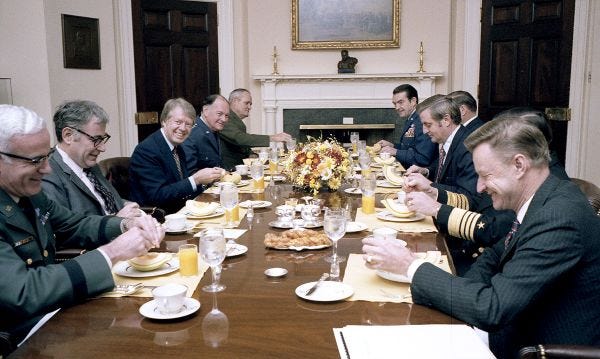
President Carter and his national security team. Image courtesy of GWU/NSA.
Nuclear planning and procedures, including for large-scale exchange, were not abstractions in the Carter administration- especially for the president. President Carter, more than perhaps any other U.S. president, immersed himself in nuclear procedures and plans. He is possibly the only sitting president to have participated directly in a nuclear decision conference exercise and gave directions for improving the format of decision materials. While William Burr rightly notes there is much we still don’t know, he concludes “While Carter raised questions about the presentation of SIOP [Single Integrated Operating Plan] options, so far as can be told, he did not question the targeting arrangements themselves or the high damage expectancies built into the SIOP.” These targeting arrangements included options such as those against Soviet nuclear forces for damage limitation as described in the earlier NUWEP. Indeed, Carter who had previously been an advocate of a minimalist approach to deterrence, underwent a “conversion” while president- a conversion that included proceeding with the development of the MX missile, a counterforce weapon par excellence.
The Reagan administration largely accepted the logic of Nixon-Carter targeting policy and force investments, simply adding more resources. Yet it innovated in key areas for damage limitation. One strategic innovation beyond Nixon-Carter was the Strategic Defense Initiative, a huge program of damage limiting defenses. Another was the Maritime Strategy, a publicly articulated strategy of threatening to use the period of conventional conflict that would precede nuclear use to attack Soviet strategic targets, most notably Soviet ballistic missile submarines- essentially a conventional counterforce campaign for damage limitation. A final innovation was urgent investment, directed by the president, in the ability to hold the emerging Soviet mobile missile force at risk.
This combination of investments in damage limitation over multiple administrations resulted in grave doubts by Soviet leaders in the current and future prospects for the survivability of their nuclear forces- exactly the situation that would yield bargaining advantage had a crisis emerged. More importantly, Soviet cognizance of this reality was likely to deter them from entering in to crisis to test the resolve of the United States. In short, by the late Cold War U.S. damage limitation capability provide a realistic and credible escalation advantage that bolstered deterrence.
Binding Agent: Damage Limitation and Alliance
Apart from the crisis bargaining advantage provided by damage limitation, this capability was central to alliance cohesion in the Cold War. As the comments from President Nixon regarding “screwing with Allies” underscores, this was well understood in the White House and Pentagon. Chairman Deng’s comments to Dr. Kissinger illustrate the extent to which allies and partners also appreciated its utility.
External analysts ranging from the RAND Corporation to the Cato Institute also understood the connection between damage limitation, first-strike stability, and extending deterrence to allies. At RAND, Glenn Kent and David Thaler forthrightly noted:
The most important conflict arises between the objectives of enhancing first-strike stability, on one hand, and extending deterrence and limiting damage on the other; i.e. the more robust the Soviets believe first-strike stability to be, the less they might hesitate to precipitate a deep crisis by engaging in serious aggression, for example, in Western Europe. Balancing between first-strike stability and extended deterrence presents a problem in the planning of strategic forces.
Their RAND colleague Paul Davis termed this trade-off “the devil’s dilemma.”
Earl Ravenal, long-time associate of the libertarian Cato Institute, offered an even lengthier treatment of the linkage between counterforce, damage limitation, and alliance:
American protection of Western Europe requires both initial conventional defense and credible extended deterrence. One cannot be substituted entirely for the other. Extended deterrence, in turn, requires the practical invulnerability of American society itself to Soviet attack. (This is not to be confused with the invulnerability of American nuclear weapons.) I say “practical” invulnerability, since absolute invulnerability is beyond America’s, or anyone’s, reach. Rather, what is necessary is the ability to limit damage to “tolerable” levels of casualties and destruction. This is so an American president can persuade others that he would risk an attack on the U.S. homeland, or that he could face down a threat to attack that homeland, in the act of spreading America’s protective mantle over Western Europe and other parts of the world. That is the key point.
Ravenal then emphasized that this connection was not just to keep the Soviets from initiating crisis or conflict. It was also to ensure that U.S. allies remained bound to the United States:
For extended deterrence to work, the escalatory chain must seem to be unbroken. But, in the case of Europe, the United States’ rhetorical assurances are seriously contradicted by its actions. Quite understandably, from the American perspective, the United States seems to be putting time and distance between the outbreak of war in Europe and the decision to use its strategic nuclear weapons. Virtually any change in U.S. military doctrine or posture- up, down, or sideways-can be seen to have the effect, if not the purpose, of decoupling the United States from Europe…
Ravenal’s solution to theses tensions was to shift U.S. grand strategy away from alliances- towards isolationism or “restraint” in the modern parlance:
Thus we encounter the ultimate contradiction between crisis stability and deterrent stability. There is no way to escape this contradiction. It is not a peculiar weakness in my case. It is simply a fact of life. There is an essential tension, not an easy complementarity, between achieving safety for Americans through crisis stability and achieving safety for the objects of American protection in the world through deterrent stability. But the United States can lessen the incidence of this tension by diminishing its obligations to extend nuclear protection.
Yet if, as Mr. Colby describes, the United States instead wishes to make alliance cohesion one of the central elements of deterrence, it is left with the need for significant damage limitation capability to ensure the coupling of allies to the United States and its nuclear forces.
It is finally worth noting the connection between extended deterrence and U.S. nonproliferation objectives. A large part of the reason the United States extends nuclear deterrence to allies is to convince them, in concert with other measures, to forego their own nuclear weapons. This was a major objective in the Cold War, particularly with regards to German proliferation. In the 21st century this may no longer be the same sort of concern- perhaps the United States would be less concerned about so-called “friendly” proliferation today. Yet there would be consequences to such proliferation and these consequences should be explicitly considered in U.S. strategy.
Conclusion: Outside Voice/Inside Voice
I conclude by admitting it is rather unfair to hold an official’s public speech to a standard of completeness. It is far easier to speak candidly and completely in private, particularly about nuclear strategy. All of my quotations above from official discussions and documents were originally classified, generally with markings like Top Secret/Sensitive. As I have described elsewhere, any public discussion of damage limitation runs the risk of appearing buffoonish or mad. Such was the fate of Reagan administration official T.K. Jones. Mr. Colby’s speech may therefore be an example of wisely and appropriately not saying the quiet part out loud.
Yet public discourse is shaped by official remarks. The elision of damage limitation in this cogent speech may lead observers- both domestic and foreign- to conclude the United States now eschews such options and capabilities. This could lead to misperception, so even if unfair to Mr. Colby I thought it worthwhile to highlight why damage limitation has been an important fourth element of the Cold War version of the military-strategic framework he ably describes.
I suppose the good news is that if we pursue the foreign policy desires of Elbridge Colby's current boss -- or especially the "next generation" of MAGA leaders like J.D. Vance or Tucker Carlson -- we really won't run a risk of these abstractions becoming reality, since we won't be caring what our near-peer rivals like China or Russia are doing in their "spheres of influence."
If the U.S. wasn't committed to the defense of Europe and key allies in E. Asia during the Cold War, then -- by definition -- the chance of a crisis turned nuclear war w/ the USSR would have been much, much lower. Everything we take for granted in discussing the Cold War -- the large standing military, elaborate SIOPs and OPLANs, the military-industrial complex, the theories of Schlesinger, Kahn, Nitze, etc. -- existed because of the international security order the US built & was committed to defending.
Had the US in 1945 pursued the course it had in 1919 -- the approach America First 1.0 demanded right up til Pearl Harbor -- then there might not even have been a Cold War... at least not in the same sense as what actually developed. This is just basic logic--if you refuse to fight over X, Y, Z, then -- by definition -- you cannot have a war over X, Y, Z.
Colby may consider himself to be a "realist" -- not an isolationist -- but he's currently in service of an administration that is pretty open about its desire to demolish the post-war security order. Strategic nuclear planning during the Cold War -- but also up until today -- was/is inherently wrapped up in the maintenance of said US-led international order.
If we blow up that order -- especially deliberately so -- nuclear strategy changes overnight. There is no longer an "adversary" for whom to plan against. I obviously understand that doesn't mean rivalry disappears and it's not as if I think a Pres. Candace Owens is going to pursue unilateral nuclear disarmament. Nuclear weapons remain a hedge in the world Colby is helping to create, but they actually would figure far, far less prominently in anything resembling strategy. You don't need a sophisticated SIOP to badmouth the Europeans about being too secular or allowing too many brown people in. You don't need to make distinctions between damage limitation or escalation dominance in order to snatch up South American presidents.
Now, it's also true that in a post-America environment, you almost certainly get a plethora of new nuclear powers overnight. Poland, Germany, Japan, S. Korea, Saudi Arabia, etc. This makes for a far more dangerous world but as long as the US remains committed to simply being the hegemon of the western hemisphere, the intricate & sophisticated strategic paradigms like we're discussing are effectively unnecessary.
In other words, Colby may want a Plan B career-wise, as his bosses (or at least people in his bosses' circle) may make his role as a geopolitical/defense strategist quite unnecessary.
Something else that occurs to me, following on from the issue about US resolve.
Although I do see the logic of your position, something I find a bit disturbing about the views on display here is that they're kind of de facto undemocratic. The idea that any non-zero risk of significant US civilian casualties would be a price worth paying for Taiwanese independence would be extremely unpopular with the US public if they were made aware of the kind of issues we're discussing here. This isn't like the Cold War, when people on the street had a legitimate fear about fate of the US itself if the Soviets subdued western Europe or the Middle East.
That's not to say that questions like this should be up for referendum, but I think there's a responsibility to be faithful stewards of the public trust when it comes to matters of life and death.