

Variable MADness
A Summary Critique of the Theory of the Nuclear Revolution

I have somehow wandered on to a panel with Charlie Glaser and Caitlin Talmadge about nuclear strategy at MIT next week- I blame Vipin. Yet it is an opportunity to try to succinctly convey my views on why the set of hypotheses on nuclear weapons and international politics known as “the theory of the nuclear revolution” are, despite their logical elegance, fundamentally flawed both theoretically and empirically. The implications of these flaws explain persistent divergence between the theory and observations.
This is in some sense an executive summary of a number of disparate things I have written on this topic and is dedicated to the memory of former Secretary of Defense Harold Brown (1927-2019), who would have been 98 last week. From leading the design of the first Polaris SLBM warhead at Lawrence Livermore through multiple tours in the Pentagon and after, Brown was brilliant and effective. His work over decades was central to U.S. strategic posture, including capabilities for damage limitation, and the outcome of the Cold War. He is missed.

Harold Brown (right) with another Cold War giant, Johnny Foster. Image courtesy of LLNL.
The Waltzian Underpinning of the Theory of the Nuclear Revolution
The theory of the nuclear revolution (or TNR as it is often stylized) is most cogently laid out in Robert Jervis The Meaning of the Nuclear Revolution, which built on his earlier work, particularly The Illogic of American Nuclear Strategy. It also incorporated a body of previous theoretical work, which included Thomas Schelling and, importantly, Kenneth Waltz. Another key work in TNR is Charles Glaser’s Analyzing Strategic Nuclear Policy, which likewise builds upon Schelling and Waltz.
The key theoretical insights of TNR are, as Jervis summarized, “there will be peace between the superpowers, crises will be rare, neither side will be eager to press bargaining advantages to the limit, the status quo will be relatively easy to maintain, and political outcomes will not be closely related to either the nuclear or the conventional balance.” These insights all flow logically from the empirical establishment of a military balance under which “neither side can launch a first strike that is successful enough to prevent retaliation from the other” — a condition of “mutual second-strike capability.” A slightly stronger formulation- mutual second strike of sufficient magnitude to assure the destruction of both societies- is known as mutually assured destruction (MAD).
Jervis noted that establishing MAD was not automatic with the development of nuclear weapons- it took investment by states. But both he and Glaser believed that once established, MAD was “a fact, not a policy.” Glaser describes this in terms of “an action-reaction competition between economically and technically capable superpowers” where modest investments by one side in its retaliatory force will readily offset very substantial investments in offensive capabilities by the other side. Thus Glaser continues “…MAD will be preserved and competition will not be intense.” This latter point on competition is only logical- investing heavily in competition that is expensive but cannot achieve advantage is irrational, best left to apes on a treadmill. Jervis, writing of MAD in the Cold War, similarly noted “[n]either superpower will allow the other to gain what it thinks might be a decisive advantage… Nuclear arms are not so expensive and the American lead in technology is not so great that the Soviet Union cannot develop important systems that are available to the West.”
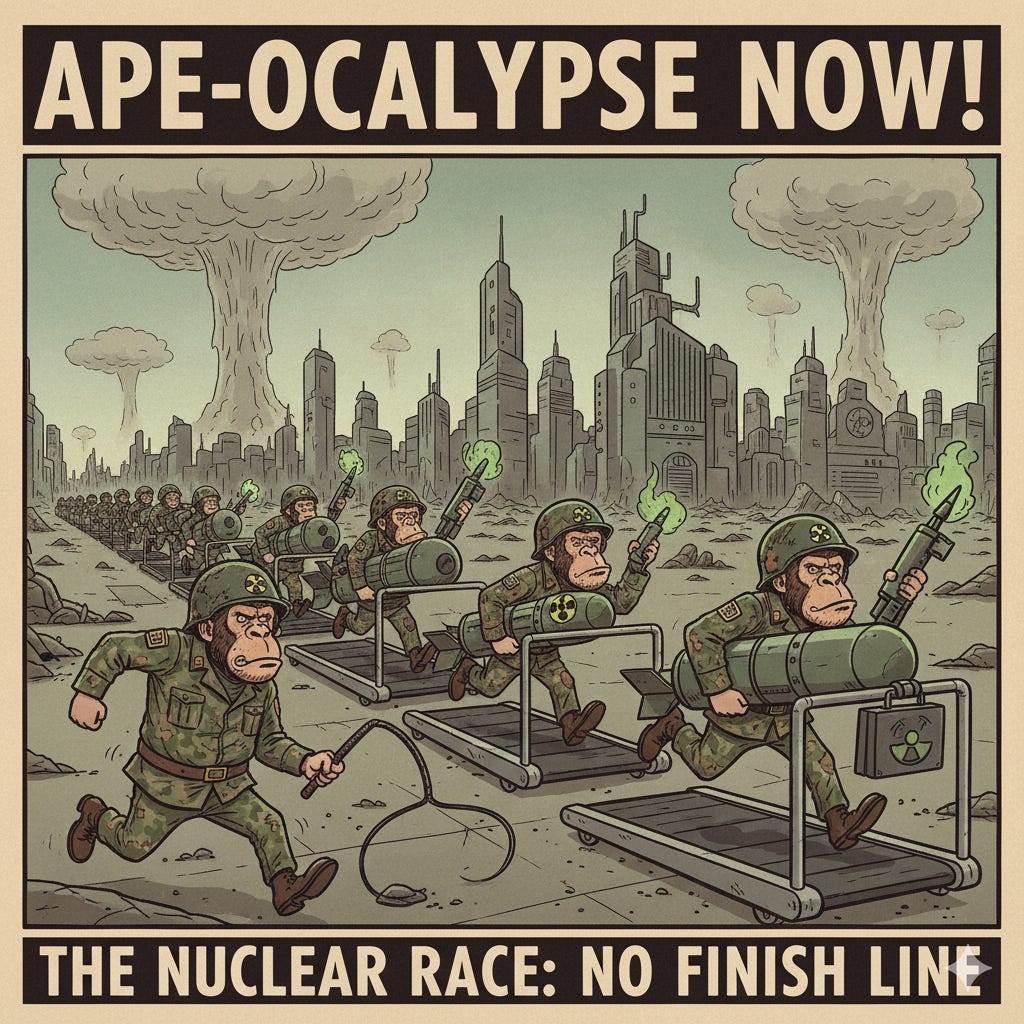
AI generated image courtesy of Gemini
The references by both Glaser and Jervis to “superpowers” in describing the inescapable nature of MAD highlights a key theoretical underpinning of TNR: the structural realism of Kenneth Waltz, as outlined in his seminal Theory of International Politics. In Waltz’s theory, international politics is a function of the international system (anarchy), the units (states) and the distribution of capabilities (power) among the units. The Cold War, in this view, was bipolar in that the the United States and Soviet Union held the preponderance of power in the system and thus formed two poles as “superpowers.” These superpowers could balance one another militarily by generating forces from within themselves- a process known as “internal balancing.” Jervis references Waltz in describing the inescapability of mutual second strike: “[i]nternal balancing, then, allows each side to deny the other long-term important advantages.”
TNR and its important condition that “MAD is a fact, not a policy” thus rests both on the particular technologies of nuclear weapons AND the distribution of power in two preponderant units- “superpowers.” These superpowers are capable of internally balancing against one another, though Glaser carefully caveats further that these superpowers must be “economically and technically capable.” It was assumed during the Cold War that both the Soviet Union and United States met these criteria. That conclusion seems unwarranted based on post Cold War research.
A Losing Proposition but One You Can’t Refuse: Soviet Fitness for Economic and Technical Competition
Put bluntly, the Soviet Union was unfit for economic and technical competition with the United States in the late Cold War. Drawing on the excellent conceptual and empirical work of Alan Milward, Aaron Friedberg, and especially David D’Lugo and Ronald Rogowski, Brendan Green and I have argued the Soviets had poor “constitutional fitness” for the late Cold War competition. Constitutional fitness in this sense means the alignment of a state’s domestic political and economic arrangements for the generation, extraction, and direction of resources to the particulars of a military-technical competition. If the state’s domestic arrangements are better-aligned to the military-technical competition than its adversary it has an advantage in “comparative constitutional fitness.”
The Soviet Union as a highly militarized authoritarian (if not totalitarian) regime with vast natural resources, was reasonably fit for the early Cold War economic and military-technical competition with the United States. From an economic perspective the brute force industrialization of the Stalin era, vividly captured in Stephen Kotkin’s Magnetic Mountain, ensured that the Soviet Union was capable of massive quantities of production. Capital investment in new factories and mines along with the clearing of new agricultural land ensured continued Soviet economic growth through the early to mid 1960s. From a technical perspective, Soviet scientists and engineers were excellent and, drawing on additional expertise from the defeated Germans and Soviet espionage, were able to compete in the early nuclear, missile, and space arenas. In contrast, as Aaron Friedberg describes, the United States federalist, anti-statist constitutional and societal arrangements limited the state’s resource extraction. This meant neither side had much of advantage in constitutional fitness in the early Cold War competition, though the United States had an early lead in nuclear weapons technology.
Thus after starting with an early disadvantage, the Soviets were, through a quantitative build-up, able to establish a nuclear posture that fulfilled the conditions of MAD by the mid to late 1960s as the United States set limits on the size of its nuclear force. From the perspective of TNR, this is where the competition culminates- in the stalemate of mutual second-strike. Both sides should have recognized the futility of competition between economically and technically capable superpowers and the logical predictions of TNR should have dominated the late Cold War. Instead, the nature of the competition changed- both economically and technically- and the Soviet Union became much less constitutionally fit for the competition in comparison to the United States.
Economically, the Soviet model of capital investment-driven began to lose steam by the mid-1960s, leading to what the Soviets called “the period of stagnation” in the 1970s. The competition began to hinge on productivity rather than just resource extraction and capital investment. Here the United States was advantaged (albeit facing its own economic ills in the 1970s). The Soviet Union and its economic bloc began to depend heavily on the West for a variety of inputs, including grain. Fortunately for the Soviets, well endowed with oil, the massive increase in oil prices from the oil shocks of the 1970s provided some liquidity and hard currency through exports, though this had negative long term effects.
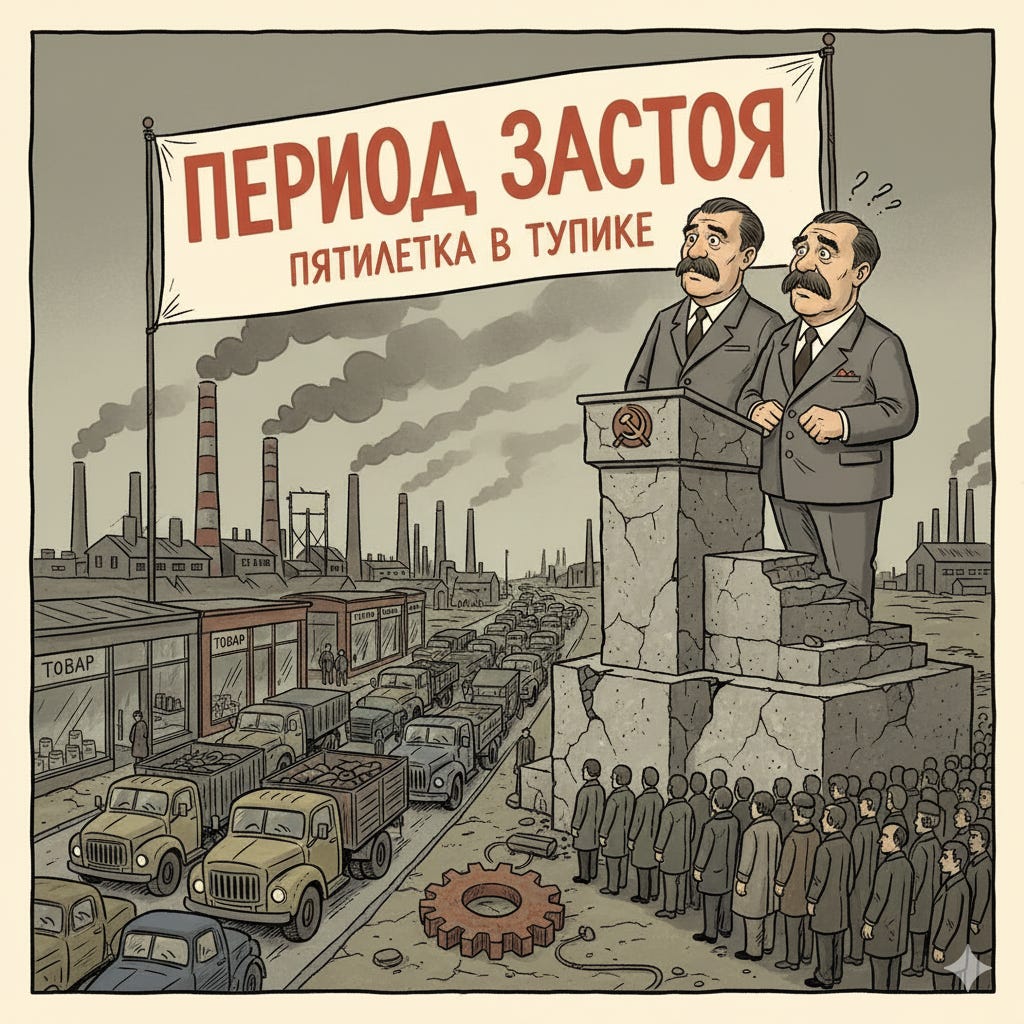
AI generated image by Gemini. The Russian banner reads “Period of Stagnation: The Five Year Plan is at a Dead End”
Overall, however, it was clear to Western observers both in and out of government that “something had to give” in the Soviet economic and military-competition with the United States. By the mid 1980s, CIA estimated the Soviets had been devoting 16 to 18% of their GDP to defense (broadly defined) since at least the late 1970s. This was probably at least double comparable U.S. spending. Retrospective assessment by Russian historian Irina Bystrova puts the Soviet defense burden even higher- responsible for 25% of GDP. Bystrova also assesses that the defense sector absorbed 75% of Soviet investment in research and development through a centralized mechanism that Matthew Evangelista demonstrates generally lagged the United States decentralized approach.
The Soviet situation was even worse in specific elements of the military-technical competition. As Owen Cote has described, the Soviets were not able competitors in the undersea domain, only belatedly producing a small number of quiet nuclear submarines. This left them unable to threaten U.S. ballistic missile submarines, while their own remained vulnerable even in so-called “bastions” near the Soviet Union. The Soviet Union was also a less able competitor in technical intelligence, stealth, and a host of other technologies. Only a massive effort to extract technology from the West kept the Soviets remotely competitive- and in the 1980s the West began to tighten the screws on this effort. In strategic forces, the Soviets recognized the limits of their quantitative approach as the United States developed qualitative responses such as high accuracy, highly MIRVed ballistic missiles. U.S. arms control efforts also helped shift the competition as both sides agreed to limit quantities of weapons with far fewer qualitative limits.
In combination, these shifts in the nature of the economic and military-technical competition of the late Cold War left the Soviet Union at a substantial disadvantage in comparative constitutional fitness. Unsurprisingly, its leaders were fearful they could not maintain “MAD as a fact”- that they were not in Glaser’s terms “an economically and technically capable superpower.” Brendan Green and I have used a variety of archival sources, both Russian and Western, as well as post Cold War testimonies to extensively document this fear, which was acute by the early 1980s. The one test case for TNR thus culminates not in the stalemate of MAD but an increasingly lop-sided contest in which MAD looked less permanent- perhaps even already gone at the end- and thus the logic of TNR- such as the lack of intense competition- could not be expected to hold.
Importantly, it is not really the nature of nuclear weapons that varies here as much as the distribution of power, and the ability to effectively mobilize that power for competition. The Waltzian underpinning of TNR is ultimately where it empirically fails. All superpowers are not created equal and internal balancing is, even in the nuclear age, is not necessarily easy or even possible. As I have argued, it is not a given the United States will be equally fit for a competition in the 21st century but it is at least as plausible that it will be- and analysts should look to the broader nature of the competition to determine the plausibility of efforts to deny MAD.
Perfect timing Austin, I'm speaking to a class at Georgetown tomorrow about the theory behind the nuclear revolution.
The Soviet Union was not "constitutionally fit" to do many things, but it could have maintained MAD without any problems. I strongly disagree that "its leaders were fearful they could not maintain 'MAD as a fact'" - if they were fearful of anything it was that the US would believe that it can fight and win a nuclear war. I think the fear of the US launching a nuclear war was quite real. Yes, there was a sense that the Soviet Union was failing (and it was in many ways) but it was mostly because the Soviet Union wanted to maintain parity with the US. The motivations were complicated, but they wouldn't be satisfied with just maintaining MAD, which was indeed a mush simpler task than parity. But it's incorrect to say that the US was on a way to escape MAD. And certainly it's wrong to imply that an effort to deny MAD is somehow plausible today.