

Peacekeeper Redux
The Role of a Heavy ICBM in the Future U.S. Triad

In October 2023, the bipartisan Congressional Commission on the Strategic Posture of the United States (aka the Strategic Posture Commission or SPC) released its final report. It concluded that the strategic environment confronting the United States required modifications to U.S. strategic posture. First among the modifications they recommend is to:
Address the larger number of targets. The Chinese nuclear threat is no longer a “lesser included case” of the Russian nuclear threat, resulting in the need to deter and achieve objectives against China and Russia simultaneously should deterrence fail.
Just a few months later, the United States Air Force informed the Congress that the new Sentinel intercontinental ballistic missile (ICBM) had undergone major cost growth:
On January 18, 2024, the Air Force notified Congress that the Sentinel program exceeded its baseline cost projections, resulting in a critical breach under the Nunn-McCurdy statute. A critical Nunn-McCurdy breach occurs if the Program Acquisition Unit Cost (PAUC) or Average Unit Procurement Cost (APUC) increases by 25 percent or more over the current Acquisition Program Baseline. By statute, the respective program must be terminated unless the Under Secretary of Defense for Acquisition and Sustainment (USD(A&S)) certifies to Congress that the program meets established criteria to continue.
The overwhelming majority of this cost growth came from the recognition that Minuteman silos and other ground infrastructure, which dated back to the 1960s, were in worse shape than anticipated and were likely not fully re-usable. New silos are likely needed for much of the force, essentially requiring a massive multi-state construction project. The Department certified Sentinel met the criteria to avoid termination, and the Sentinel program has undergone some reorganization and modification. Yet it has not fundamentally changed, which is a missed opportunity to respond to the SPC’s recommendation to address the larger number of targets. A reorganized Sentinel program should include a larger, more capable missile in addition to the current missile design, enabling greater flexibility and capability.
U.S. Heavy ICBMs: The Past as Prologue
This diversified missile fleet would be a return to the past. For most of the Cold War the United States operated an ICBM force composed of more than one type of missile. In the 1960s and 1970s, the two primary systems were the solid-fueled Minuteman fleet and the heavier liquid-fueled Titan fleet. In the 1980s Titan was retired while the solid-fueled heavy Peacekeeper ICBM entered service alongside Minuteman. With the end of the Cold War and signing of new arms control agreements, the United States retired Peacekeeper in 2005 while retaining the older Minuteman III.
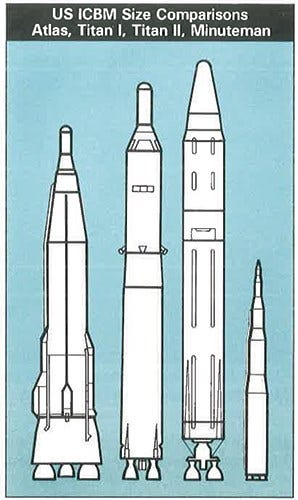
ICBM comparison. Image courtesy of National Park Service
As a result of Peacekeeper retirement, when the United States developed the current strategic modernization program, it conceived of the Ground Based Strategic Deterrent (GBSD) program as essentially a “like for like” replacement for Minuteman. While GBSD, now known as Sentinel, will be more capable than Minuteman III it will likely have fundamentally similar physical dimensions and mass. This suggests Sentinel will, like Minuteman III, be capable of carrying up to 3 multiple independently targetable re-entry vehicles (MIRVs)- and the SPC recommends it be deployed in a MIRV configuration. In contrast, Peacekeeper was much larger and capable of delivering up to 10 MIRV warheads.
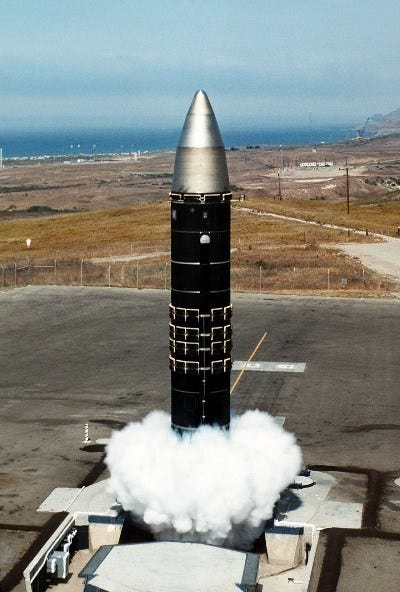
Peacekeeper test launch. Image courtesy of National Park Service
Peacekeeper was highly capable, but it was controversial given it would be seen as a lucrative target for adversary preemptive attack. The debate over its deployment and the pursuit of a survivable basing mode dragged on for years. This controversy was finally resolved by a Presidential Commission on Strategic Forces chaired by former National Security Adviser Brent Scowcroft. The resolution had many parts, but the key one was to recommend that a limited number of Peacekeeper missiles (50) be deployed in existing Minuteman silos. The Commission noted on the survivability issue:
In the judgment of the Commission, the vulnerability of such silos in the near term, viewed in isolation, is not a sufficiently dominant part of the overall problem of ICBM modernization to warrant other immediate steps being taken such as closely-spacing new silos or ABM defense of these silos… To deter such surprise attacks [on ICBM silos] we can reasonably rely both on our other strategic forces and on the range of operational uncertainties that the Soviets would have to consider in planning such aggression…
The Scowcroft Commission recommended pursuit of a smaller mobile ICBM in parallel to Peacekeeper- a recommendation echoed by the more recent SPC. Whatever one thinks of the merits of a mobile ICBM (and the United States was developing one when the Cold War ended) it is not necessarily in tension with the deployment of a heavy ICBM.
The Merits of a Heavy ICBM
A heavy ICBM would be a major contributor to delivering on the SPC’s recommendation to address the larger number of targets. A maximally loaded full deployment of Sentinel would carry 1350 warheads (150 missiles per missile wing x 3 missile wings x 3 MIRVs). Assuming a heavy ICBM were roughly as capable as Peacekeeper (so let’s call it Peacekeeper II) one wing of missiles could easily match the entirety of the Sentinel force (150 missiles x 9 MIRVs). While neither of these configurations is operationally likely, it highlights the capacity advantages of a Peacekeeper II.
This capacity provides enormous flexibility to the future ICBM force, important both for the strategic issues the SPC highlights and for the programmatic issues that Sentinel Nunn-McCurdy growth underscores. In addition to cost growth, the Sentinel program will deliver significantly later than anticipated, partly due to the need to construct new silos. This means the Minuteman force will need to remain in the field longer, which is already challenging and costly given the age of the system. Originally Minuteman was to end service life in 2036- now the Air Force believes the delay to Sentinel means it may need to maintain Minuteman until 2045 or 2050.
If development of a Peacekeeper II were to begin now it could plausibly be ready to field by the late 2030s as it could leverage technologies already being developed for Sentinel, such as the guidance system. This would enable it to potentially be deployed as a full missile wing by the early 2040s. For comparison, Peacekeeper, which did not leverage Minuteman III systems such as guidance, took twelve years (1974-1986) from the beginning of full-scale development to initial deployment. Together with a missile wing of Sentinels, these 300 missiles (150 Sentinels and 150 Peacekeeper IIs) would be able to cover more targets than the entire currently planned Sentinel force. This would permit the full retirement of Minuteman sooner and with fewer replacement missiles in the field- saving money and lowering technical risk of keeping Minuteman in service for more than 70 years.
The United States could then complete deployment of a second wing of Peacekeeper IIs resulting in vastly more target coverage but without having to continue maintaining Minuteman as it did so. Alternatively, if the security and/or arms control environment in the 2040s is better than the current environment, the United States could choose to forego modernization of the third missile wing or delay it.
In addition to fielding greater capacity more quickly, a Peacekeeper II would also permit larger MIRVs to be effectively fielded, which could include maneuvering ballistic RVs or hypersonic glide bodies. Peacekeeper II would also have substantial capacity for missile defense countermeasures. This combination helps address concerns about future adversary defenses as well as challenges in overflight of countries not involved in a hypothetical conflict.
While developing a Peacekeeper II would add to the cost of nuclear modernization, it could use the same design as Sentinel for the command and control and silo/launch infrastructure. Assuming nothing is done in the design of the silo to preclude it, using the same silo design should be straightforward- a canisterized “cold launch” technique meant that modifications to Minuteman III silos to enable Peacekeeper launch were modest. The marginal cost would thus be confined to the development of the new missile (again leveraging Sentinel technology), the additional per unit costs associated with a larger missile (more fuel, etc.), procurement of a larger missile transporter, and whatever loss of production and maintenance efficiency is imposed by fielding smaller numbers of two systems rather than more of a single system. This increased cost would be partially offset by earlier retirement of Minuteman III.
Addressing Risks of a Heavy ICBM
As the Peacekeeper basing debate illustrated, a heavy ICBM that is highly MIRVed raises concerns about first strike incentives for adversaries. Indeed the 2010 Nuclear Posture Review (NPR) concluded that completely “deMIRVing” Minuteman III was best for stability:
Today, the United States has 450 deployed silo-based Minuteman III ICBMs, each with one to three warheads. The NPR considered the type and number of ICBMs needed for stable deterrence, and to serve as a hedge against any future vulnerability of U.S. SSBNs. The United States will “deMIRV” all deployed ICBMs, so that each Minuteman III ICBM has only one nuclear warhead. (A “MIRVed” ballistic missile carries Multiple Independently targetable Reentry Vehicles (MIRVs). “DeMIRVing” will reduce each missile to a single warhead.) This step will enhance the stability of the nuclear balance by reducing the incentives for either side to strike first.
Yet the Scowcroft Commission’s position on Peacekeeper and stability is more relevant to the current and future security environment than the 2010 NPR view. The 2010 NPR view prioritized stability over ICBM capacity in the security environment of the time- Russia had not yet invaded Ukraine (the first time), China had not begun its “strategic breakout,” and North Korea had only tested nuclear weapons twice. The security environment today calls for different prioritization- acquiring modern, highly capable nuclear systems appropriate for the security environment should be the highest priority, as it was in 1983.
In the context of the geopolitical environment and status of the nuclear modernization program of 1983, the Scowcroft Commission viewed a limited number of Peacekeepers in silos as not particularly concerning from a first strike stability perspective. The same logic applies now and in the foreseeable future. As in 1983, the United States can rely on “other strategic forces and on the range of operational uncertainties” (the latter including the potential for U.S. launch on warning) to deter large scale surprise attack on silos.
Indeed, other U.S. strategic forces today and in the future are superior to those at the time of the Scowcroft Commission. In 1983 the United States had just begun fielding the Ohio-class submarine and had yet to field the Trident D5 missile or W88 warhead. Similarly, the first U.S. strategic air launched cruise missile, the AGM-86, had just entered service in 1982 and the B-2 stealth bomber was still under development. These capabilities have since become integral to U.S. strategic forces and will be replaced in the coming decades by more capable successors.
Given the diversity and capability of other U.S. strategic forces, an adversary has very limited incentive to launch an attack on a large U.S. ICBM force even if the ICBMs are heavy and highly MIRVed- unless the adversary also has substantial capability to target or otherwise defeat the other legs of the triad. Should those other legs of the triad come under pressure in the future (e.g. from antisubmarine warfare developments), then additional efforts can be made to enhance survivability of silo-based Peacekeeper IIs- e.g. missile defenses as noted by the Scowcroft Commission. The Trump Administration’s Golden Dome for America project already envisions such a potential role for missile defense, noting in the original executive order establishing the project that “[t]he United States will guarantee its secure second-strike capability.”
Finally, it is worth noting both Russia and China currently field heavy ICBMs and are in the process of developing or fielding new ones. Russia continues to field the RS-36 Voyevoda (aka the SS-18 mod 6 “Satan”) and is developing the RS-28 Sarmat as a replacement (albeit with some issues). China fields the DF-5 (aka CSS-4) and included the newest version, the DF-5C, in its Victory Day parade in September 2025. This indicates that both see such systems as sufficiently valuable as to outweigh any stability concerns. It is also suggestive that a similar U.S. system could provide useful leverage for deterrence and, eventually, arms control.
Conclusion: A Jaws Moment for the U.S. ICBM Force
In one of my favorite scenes from the movie Jaws, Chief Brody (Roy Scheider) mutters the famous line “you’re gonna need a bigger boat” after first seeing the titular great white shark, far more massive than he had envisioned. The current and likely future security environment the United States is likewise far more daunting than that envisioned when the Sentinel program was established. Unlike Chief Brody, the United States has an opportunity to avail itself of a bigger boat and should seize the opportunity as it completes the reorganization of the Sentinel program.
While not endorsing the entire argument about whether a new U.S. heavy ICBM is necessary or appropriate, the central point of piece about the need for a much wider discussion of what do to with the ICBM force should occur. The disastrous cost overruns and delays of Sentinel provide a window to think through new options for the more competitive and hostile geo-strategic environment we find ourselves in. The view when Sentinel was begun was the program was a cheap and straightforward way to modernize the ICBM force. For a variety of reasons, many entirely foreseeable, that has not been the case.
Creative options including mobile missiles, heavy ICBMs, fewer fields, and perhaps even getting rid of the ground-based portion of the deterrent should be considered. Options should be weight on their benefits for deterrence, total costs, and how they will shape views among our adversaries and allies. In a funny way we are at a moment where a Nuclear Strategic Posture review would make a lot of sense at the exact time the Trump administration has decided not to do one.