

Coming Up Short
some cartoonish calculations for Iran breakout scenarios

Below I play around a bit with breakout timelines; the computations are quite crude, but get at a basic conclusion that even a nuclear deal with Iran that eliminates stocks and installed centrifuges can’t do as well now as the JCPOA did in 2015 in terms of adding to the time it takes to produce the material for a weapon. This conclusion underlies some of the analysis Nate Swanson and I did in a recent article, which gets at the obvious question of “so what do we do about it?” This post just plays around with the numbers.
The JCPOA’s constraints on Iran’s nuclear program were designed around the concept of “fissile material breakout time.” This is the time needed to produce the fissile material for a single nuclear weapon using the centrifuge capacity available to Iran.
Computing the details of a breakout scenario, and the breakout time it requires, is complicated, and informed by lots of information and the input of lots of smart people. But a much simpler cartoon model can be useful in evaluating and comparing different sets of potential nuclear constraints. In particular, we can use a much-simplified treatment to compare the current zero-zero proposal under discussion between U.S. and Iranian negotiators (i.e., zero enrichment for some amount of time and zero stocks of enriched material) to the one-year fissile material timeline under the 2015 JCPOA. The unfortunate reality is that because Iran has significantly improved its capabilities since the U.S. withdrawal from the JCPOA in 2018, even the most extreme zero-zero solution provides significantly less cushion than the JCPOA’s provisions offered.
The Model:
Enrichment is a process by which feed material is turned into more-enriched product and less-enriched tails. That process represents a decrease in entropy and thus requires the application of thermodynamic work; in Iran’s case, that work is applied in a collection (or cascade) of centrifuges.
There are some basic physics constraints on how this can happen. Conservation of mass says that you can’t get more or less material out than you put in, so the masses of feed, product, and tails are related by the first equation below. If the enrichment level of each of these three material flows – basically the fraction of the material that is composed of the fissile uranium isotope U235 – is represented by xf, xp, and xt , thenthe mass of U235 must also be conserved, yielding the second equation.
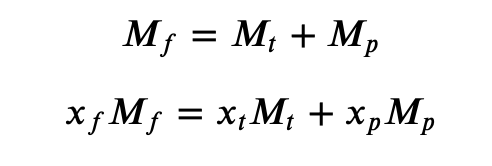
We can use these equations to relate the amount of material in the inputs and outputs of the enrichment process as a function of their different enrichment levels.
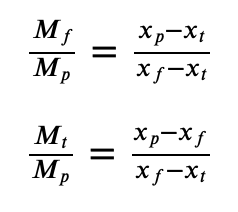
For example, if you wanted to turn 3.67%-enriched material into 90% material, with 1.5%-enriched tails:
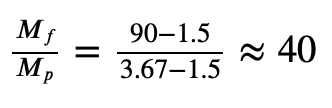
meaning you’d need about 40 times as much feed material as you want product, or 1,000 kg of 3.67% feed to produce 25 kg of 90%.
With those relationships established, enrichment capacity can be introduced, essentially the means by which to account for the thermodynamic work needed to carry out the enrichment process. See the references in this paper for the detailed derivation, but the punchline is that the enrichment capacity C can be defined so that:

And the value function V at each point is defined as:
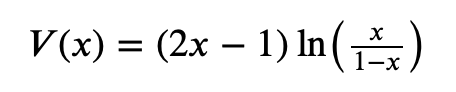
These terms just do the job of making the thermodynamic work match up so you’re not reducing entropy for free or something equally illegal.
Trying it Out for the JCPOA:
Let’s try out a simple model from these key parameters, namely the JCPOA-ish scenario of enriching from natural uranium to 3.67%, and then from there to 90%.[1] Using the equations above, you can calculate that:
· 1 kg of 90% material requires about 40 kg of 3.67% material as feed (I assume 1.5% tails)
· Doing that requires about 40 SWU per kg of product
· 1 kg of 3.67% material requires about 8.5 kg of natural uranium feed (I assumed 0.003% tails)
· That requires about 4.7 SWU per kg of 3.67% material produced
With these rough numbers, you can play around with breakout times. Just multiplying, you find that making 25 kg of 90% material straight from 3.67% feed would cost about 25x40=1000 SWU and 1000 kg of feed. To create that material, every month the available capacity can be applied, producing a kg of material for every 4.7 SWU available[2]. Taking a JCPOA solution, in which you start with 5,000 SWU already operating and 300 kg of 3.67% material, and assuming that in addition to using the centrifuges you already have, you install new cascades of the same model at a rate of two cascades (say 170 centrifuges each) per month, we can chart month by month how long it takes to reach a weapon’s worth of material:
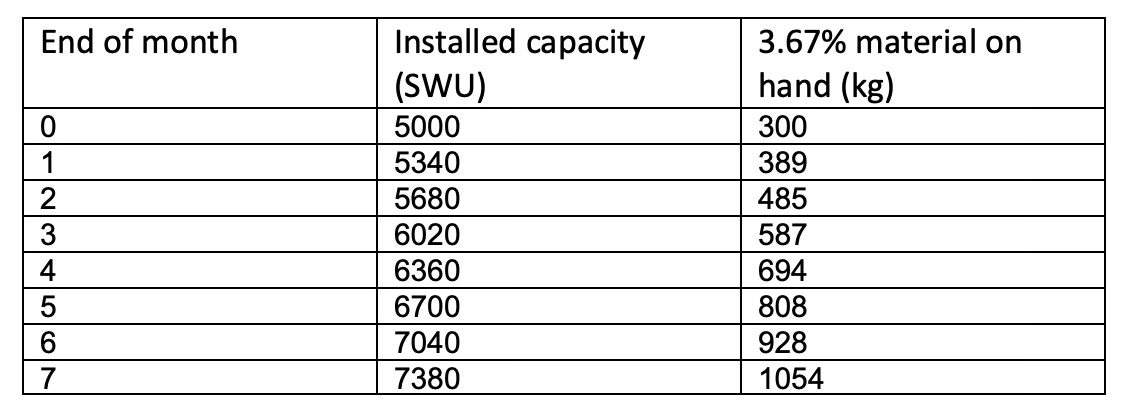
Thus the raw 3.67% material needed for a weapon is in hand at the end of the seventh month after starting breakout. 1000 SWU is needed to bump this material up to 90%; that would take just under 2 months if the entirety of the installed capacity could be instantaneously reconfigured, bringing the processing timeline to nine months. In reality, it would take some time to do this reconfiguration, which (with some hand-waving) is how the total breakout time gets to closer to a year. If Iran was worried about wasting its valuable 3.67% material (for example so that it could build a second weapon), it might introduce an intermediate enrichment stage at 20%, pushing timelines out further (but using 3.67% material more efficiently). There are a million details to add in here, but this is the basic picture.
Now let’s look at a situation in which Iran has shown itself to be capable of installing cascades at closer to 6 cascades per month, and the centrifuges in those cascades are much higher-performance, more like 6 SWU.[3] Now the enrichment capacity of the new centrifuges quickly outpaces that of the original 5,000 IR-1s allowed by the JCPOA.
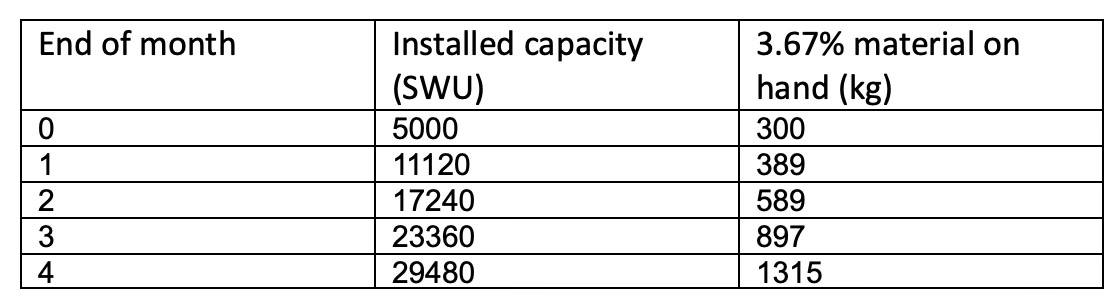
The dramatically faster accumulation of enrichment capacity means we now get our 1,000 kg of 3.67% in just over three months, rather than seven. We still need to apply 1,000 annualized SWU to this material to bring it to 90%, but now Iran can install 6,000 SWU worth in whatever configuration it likes each month; a bit less than two months is now more than enough to install and use that capacity to top the material accumulated off at 90%, and the total breakout time is thus more like four to five months, much worse than before.[4]
Press speculation about ongoing negotiations has centered on Iran’s 60%-enriched material, which is disastrously close to weapons-usable in any scenario. Note that the above has assumed not only that Iran has eliminated all of its 60% material, but also removed all 20% and all but 300 kg of its current stock of thousands of kg of 3.67% material, matching the JCPOA limits (if Iran keeps this material, the timelines compress dramatically). Even this is clearly disappointingly ineffective in breakout terms. How much better can we do, i.e. by going further than the JCPOA and eliminating ALL centrifuges and ALL enriched uranium stocks, in a true zero-zero option?
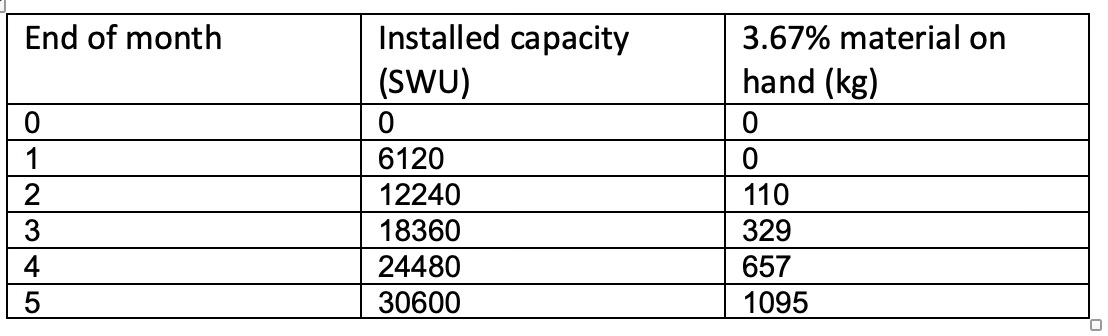
This best-case nuclear deal (at least in the sense of enrichment limits, there are other things you can try to do to plug the gap) adds about two months to the processing time, a total breakout time of maybe 6-7 months. Even here, the SWU are just accumulating too fast.
There’s an important caveat here; I’ve assumed that Iran has the centrifuges on hand to install this quickly. While Iran sustained the high-installation rate in 2025, it could have been drawing in part on stockpiled centrifuges, rather than manufacturing the new machines on an as-needed basis. We don’t know what stocks of centrifuges are on hand today, or what kind. Iran’s centrifuge manufacturing facilities have also been damaged over the past few years; IAEA monitoring of that capability largely ended in 2021, and so it’s also an unknown (at least to me) to what degree it has since been reconstituted, and where. Finally, the raw materials needed to manufacture new centrifuges could be a limiting factor, slowing down the process. If you assume that centrifuge stocks have all been destroyed and manufacturing capacity is less than six cascades worth per month, then the installation will be correspondingly slower. But you’d have to be pretty confident you have perfect insight into those parameters to bet the success of your nuclear deal on that. You could imagine adding provisions to a deal that would get at these uncertainties (e.g., destroying any stocks of centrifuges, restoring verification at that step of the process), but such elements haven’t been part of the deal parameters leaking out. I hope they’re part of the discussion.
Again, I fully acknowledge that the above is simplistic in a number of ways I identified, and surely in many more that I didn’t. My assertion is just that it’s close enough to reality to justify the side by side comparison with the JCPOA. I tried to be clear about the assumptions, which are drawn mostly from IAEA reporting; different assumptions might nudge the numbers around a bit, but I don’t think they change the core takeaway.
As Nate Swanson and I noted in Foreign Affairs, Iran’s potential for nuclear breakout is like running a race on a track: Iran wants to cover the distance from start to finish in a short time, and we want to use a nuclear deal to lengthen that time. In this analogy, the nuclear constraints in a deal have the effect of moving the starting line backwards, lengthening the race and the time it takes Iran to finish it. But as a result of Iran’s significant gains in capabilities following the U.S. withdrawal from the JCPOA, it is now an accomplished sprinter that can cover even the longer distance in a much shorter time. Unfortunately, because we cannot demand that Iran have less than zero centrifuges and less than zero nuclear material, we cannot move the starting line far enough back to compensate for these improvements, and even this extreme case is less effective in constraining Iran’s breakout potential than the JCPOA was ten years ago. In our Foreign Affairs piece, we highlight the kinds of additional measures, beyond constraints on enrichment and stocks and delving more into verification issues, that can help compensate for this lost effectiveness.
[1] There are good reasons not to do this, mostly relating to a desire to use low-enriched material more efficiently by, for example, enriching it first to 20% and then higher. But nothing prevents this one-step process, and it’s simpler to model for the purpose of making the comparison I want to make. Just don’t take it too literally!
[2] There are some factors of 12 floating around in the capacity, because the SWU levels are annual, but I’m applying that capacity for only a month or 1/12th of a year in each case.
[3] The good ISIS has a good rundown here; the cascade installation rates are just observing what the IAEA reported that Iran was doing in 2025. The SWU for the IR-6s can be estimated by looking at Iran’s production of 60% material with two cascades of these advanced machines, the production rate of which the IAEA reported in the same report. If these factors are off by a bit that propagates through what follows, but the basic idea holds.
[4] Another caveat – I’ve been accounting for installed SWU only the month after they are installed, but this probably isn’t fair when they’re being installed much more quickly than that. Properly accounting for this would speed up the process further.