

Artificial Intelligence and Nuclear Weapons
Thoughts on Risks and Rewards

The nexus of artificial intelligence (AI) and nuclear weapons has produced substantial angst in both technical and policy communities. Given the pop culture priors of the past several decades- from Colossus: The Forbin Project through WarGames to Terminator- this is unsurprising yet also unhelpful. AI is not synonymous with SkyNet or the WOPR of films, and it is unreasonable to believe that AI will or should be insulated from nuclear weapons- from design to command and control. Yet the intersection of AI and nuclear weapons also has risks. I have been asked to provide remarks on this intersection several times over the past year and for a panel at an event hosted by the Federation of American Scientist and Future of Life Institute I wrote the remarks up as a framing paper, which is the basis for this post. The below provides some initial framing for how to think about more or less risky intersections of AI and nuclear weapons. I also highly recommend Herb Lin’s Texas National Security Review article, which touches on similar themes.

Poster image for the original AI and nuclear weapons film
AI and Nuclear Weapon Design
Nuclear weapons and AI intersection can begin with design of weapons. As with other bespoke technical design areas such as pharmaceuticals, AI can potentially accelerate design cycles for weapons. However, such advancement requires substantial data on nuclear weapons performance, mostly only available from a substantial empirical record from nuclear testing as well as investments in modeling. AI will thus likely provide design benefit primarily to the United States and potentially Russia. In a sense then the rich will get richer from this interaction- the largest/oldest nuclear powers will reap the most benefit. AI and nuclear weapons design is thus a logical extension of the United States decades old scientific stockpile stewardship effort, which combined high performance computing and simulation with the data from decades of nuclear testing.
AI is thus unlikely, absent such data and modeling investment, to shift any of the underlying dynamics of vertical or horizontal proliferation. One possible exception is the People’s Republic of China, which has the resources to investment in modeling and computing but lacks a test base comparable to the United States or Russia. If it were able to gain such data- or simply chose to begin testing in a focused way- it could potentially advance its nuclear designs very rapidly compared to the progress of the United States or Soviet Union decades ago. The recent revelation that China has conducted significant yield producing nuclear tests and may intend to conduct more takes on added significance in this context.
AI and Nuclear Command, Control, and Communications
AI has multiple points of potential intersection with the command and control of nuclear weapons. This creates a spectrum of risk and benefit, from intersections of high risk and low benefit to those with low risk and high benefit. As each intersection has different implications in terms of risks and benefits, so it is useful to decompose nuclear command, control, and communications into different components or functions. Typically, nuclear command and control is defined as consisting of five functions: situation monitoring, decision making, planning, force management and force direction.
These functions can then be mapped to the risk/benefit spectrum. At one end of the spectrum are low risk/high benefit applications, where the inclusion of AI is likely to improve performance with little to no risk relative to existing command and control processes. At the other end are high risk applications, where whatever the benefits there are substantial risks over existing processes. Risk reduction approaches would seek to appropriately calibrate risks of AI and nuclear command and control intersections and then limit or eschew those that are at the risky end of the spectrum while encouraging appropriate adoption of those at the other end of the spectrum.
Situation monitoring encapsulates a spectrum ranging from early warning to assessing general geopolitical developments. AI clearly offers potential benefits here- the rapid assimilation and assessment of disparate inputs, for which there is often extensive historical data, is a core competence of AI.
For example, U.S. early warning of ballistic missile attack relies on both infrared and radar data, which are already processed with a high degree of automation. AI offers some benefit to speeding up the assessment of potential attacks by fusing sensor data with historical data (e.g. from observation of previous missile launches) as well as the potential for introduction of novel assessment tools. An example is rapid inclusion of intelligence data on adversary nuclear readiness levels and/or patrol patterns. While there is risk of AI false alarm, it is likely modest compared to the risk of false alarm with existing semi-automated assessment.
The intersection of AI and nuclear decision-making causes the most immediate visceral reaction- images of AI directed nuclear war haunt the modern consciousness. Yet decision-making tools- or more accurately aids to decision-making- have existed since the beginning of the nuclear age. In the United States the most notable is the decidedly analog Nuclear Decision Handbook (NDHB aka the Black Book), a binder with reference material to support nuclear decisions. If the same information contained in the Black Book were presented digitally- e.g. on a tablet- would it fundamentally change decision-making? What if the same information were made more visual- three dimensional displays rather than diagrams and words on a page? What if it were the same information but more interactive- with hyperlinks to additional existing data bases for example? A President can already ask for any information he or she wants in decision-making- would making information retrieval faster and without a human staff officer having to provide it change a decision? If so, for better or worse?
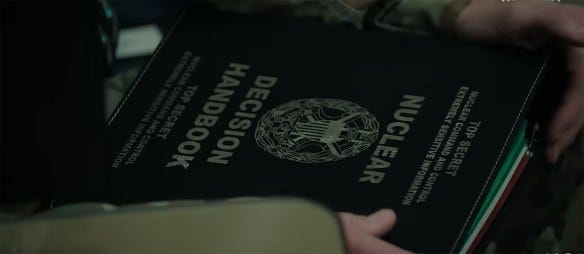
The Black Book as depicted in House of Dynamite. Image courtesy of TLDR Reviews.
Going one step further, what if the digital interface provided information that a President’s querying of data bases suggests he or she is actually seeking but is unsure how to ask for? Would this change decision-making? A further step would be the digital interface recommending courses of action with pros and cons- just as human advisors can. Each of these incremental steps away from a purely analog two-dimensional decision-aid to an interactive AI advisor are potentially reasonable but merits considerable caution given the early state of understanding of the interaction of human judgment with advanced AI. Each step probably shifts further towards the risky end along the risk/benefit spectrum
Beyond decision-aids, there is the possibility for purely AI decision-making. While nations such as China and the United States have rejected this approach, it could be potentially attractive to states with concerns about assured retaliation. In states with clear leadership succession and trusted civil military relations, such concerns can be addressed with delegation to lower echelon commanders or by ensuring clear succession and continuity of civilian leadership. The United States has pursued both courses at various points.
However, the Soviet Union- which lacked both clear succession and trust between civilians and the military to permit delegation- did not pursue either course. Instead, it built an algorithmic form of pre-delegation- a semi-automated command and control system known as Perimetr. When the system was activated and certain conditions were met the system would enable nuclear launch without further leadership action.
While not AI, the system highlights the potential attraction for certain regimes of AI decision-making. A leader concerned about assuring nuclear retaliation and unwilling to delegate or identify a successor could see AI as a convenient escape. Who better to succeed a leader that is killed or incapacitated than an AI simulacrum of the leader’s own nuclear decision-making? Whether such a simulacrum is possible- and if it is how faithfully it could recreate a leader’s decision-making- is an open question but one can imagine why a leader could invest in exploring it. This would be at the extreme end of the risk/reward spectrum.
The planning function of nuclear command and control probably sits at the less risky side of the risk/benefit spectrum, with different aspects of planning somewhat more or less risky. As an example, much of the initial processing of geospatial intelligence (e.g. satellite images) by the U.S. National Geospatial Intelligence Agency is done with the aid of machine learning tools. The volume of images now available simply swamps humans so AI/ML-human teaming makes the volume tractable and useful. These images are the basis for much U.S. military targeting (nuclear or non-nuclear), so the targeting component of planning already has an element of AI embedded in it. This to date has not produced risky results and may reduce risks of the kind that led to the inadvertent bombing of the Chinese embassy in Belgrade in 1999 during operations against Yugoslavia.
Other aspects of planning- which often already rely on modeling tools, such as those for planning flight routes- could likely benefit from similar AI-human teaming. This would be particularly useful for so called adaptive planning, which is intended to enable generation of nuclear options that are not currently in existing deliberate or “on the shelf” plans for the U.S. president in crisis or conflict. Of course, rapid generation of options could lead to challenges in other aspects of nuclear command and control- such as decision-making- if other functions of nuclear command and control are not well integrated with AI-human enabled planning. This underscores the need to evaluate AI incorporation into nuclear command and control holistically across the five functions.
Force management, which involves all the prosaic but vital elements of logistics, maintenance, and readiness, is perhaps the function where the utility of AI is most likely to be evident at low risk. This is in part because many of the elements of force management most closely resemble civilian or other military applications of AI- large geographically dispersed logistics functions for example. The detection of patterns for predictive maintenance in nuclear systems and ensuring the routine updating of cryptographic keys and software are just two areas where agentic AI in particular could prove valuable in force management. Here the risks of incorporating AI again seem modest or negligible compared to the status quo- AI may even help limit future errors of the kinds the U.S. Air Force saw in handling nuclear weapons and component in 2007.
Force direction- the issuing of commands to the force to employ or terminate employment of nuclear weapons- offers a few different potential opportunities for the incorporation of AI, with more or less risk. At the lower end of risk is the use of AI to manage the communications systems and connections required to disseminate orders to nuclear forces. In the United States these orders are called Emergency Action Messages (EAMs) and, depending on the nuclear platform, can be delivered via landline or a variety of radio frequencies. In environments where adversary nuclear or non-nuclear attack may have disrupted communications AI could be useful in ensuring reconstitution of pathways for message transition. Indeed, early packet switching techniques- which now form the basis for internet communications- were developed for such environments so AI for similar effects may be simply a logical progression.
Another application at AI would be giving it a role in optimizing force direction to achieve presidential objectives. This would enable AI to optimize in near real time how weapons would be applied to targets based on the current real-world conditions. For example, if a missile failed at launch, AI could rapidly determine whether another missile was available to cover the same target, determine whether utilizing that missile would leave another target uncovered and assess the utility of employing the second missile. This could improve both the efficiency and effectiveness of force direction- which in turn might permit a state to deploy fewer nuclear weapons. However, giving AI autonomy to redesign attack structures in real time- even if the AI must be given authorization to do so in the same way a human operator would through a presidential authentication- would be at the risky end of the spectrum of AI interactions. The shadow of Skynet and the WOPR would be long here.
Austin: One of the most thoughtful pieces I have seen on this issue Well done.
Good stuff. What do you think of James Johnson's arguments in this area, if you've seen them? https://www.jamesjohnsonphd.com/publications
Also, happy valentine's day